
Top Running
Overhead CraneManufacturer
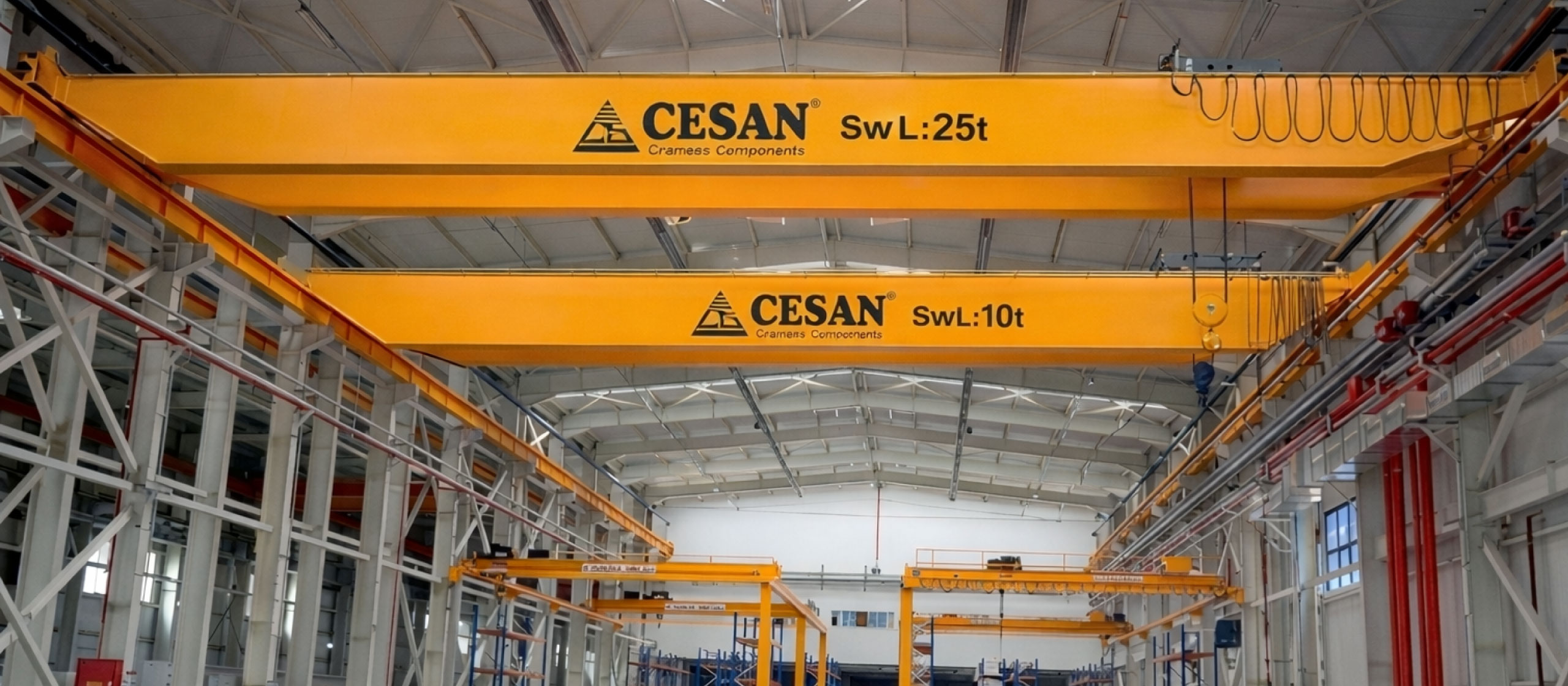
Rails on top of the runway beam — the highest hook position, the widest span, the heaviest loads. Cesan top running bridge cranes are available as single girder EOT cranes up to 25 T and double girder overhead cranes up to 500 T, engineered to FEM, DIN, ISO, and CE standards for any industrial environment.
Rail-Mounted
Bridge Crane
Higher Hook Height than Underhung Cranes
Because the bridge travels on rails sitting on top of the runway beam rather than hanging below it, a top running crane gains every millimetre of the runway beam depth as usable lifting height. In any building where ceiling clearance is the binding constraint, a top running EOT crane delivers a materially higher hook position than an under-running or underhung design — often by 300–600 mm or more. For a double girder top running crane the advantage is compounded further, since the hoist sits between the two girders at rail level rather than below the bridge.
Heavy Loads, Wide Spans, Long Service Life
Top running bridge cranes are the industry standard for high-capacity industrial lifting — capacities from 1 T to over 500 T are achievable, with bridge spans to 31.5 m and lifting heights to 30 m. The independent runway structure distributes wheel loads across dedicated support columns rather than the building frame, enabling the crane to handle higher dynamic loads without structural compromise. Cesan's smooth-start motor and gearbox design eliminates sudden movement to minimise abrasion on all running components and extend the crane's service life.
Easier to Install, Service, and Maintain
Top running cranes are easier and faster to install than underhung systems — the bridge simply rests on top of the runway rails, so it does not need to be suspended during wheel maintenance or inspection. The bridge end trucks are accessible from the maintenance platform without any special rigging. Combined with Cesan's modular design, sealed long-life bearings, and quality-selected components, maintenance frequency and cost over the crane's operating life are substantially reduced compared to equivalent capacity underhung designs.
Top Running Bridge Cranes — Industrial Standard
A top running overhead crane — also known as a top running bridge crane, overhead travelling crane, or EOT crane — is the most widely used overhead crane type in heavy industry. The bridge travels along two parallel runways installed at an elevated position, typically supported on dedicated columns or the building structure. Rails are fixed to the top surface of each runway beam, and the crane bridge end trucks ride on these rails, placing the entire bridge, trolley, and hoist above the runway beam flange.
This top-of-beam rail position is the defining advantage of the top running design: the hook hangs lower relative to the runway beam top, maximising the usable lifting height within any given building envelope. For facilities with limited headroom — workshops, warehouses, steel plants, and port structures — the top running crane consistently outperforms underhung alternatives on hook height.
Cesan top running bridge cranes are available in two primary configurations: single girder (up to 25 T, wire rope or chain hoist, bottom-flange trolley) and double girder (up to 500 T, ZX wire rope or VX open hoist, top-running trolley between the girders). Both configurations are designed and built to FEM, DIN, ISO, and CE standards, with duty classes from A3 through A7 available across the range.
- Top-of-rail position delivers maximum hook height in the building
- Handles 1 T to over 500 T — single or double girder configuration
- Wide spans to 31.5 m — coverage for large industrial floor areas
- Independent support structure — no reliance on the building frame
- No suspension required for wheel maintenance — easier to service
- Wire rope or chain hoist — pendant, radio remote, or cabin control
- VFD / inverter stepless speed control on all motions
- Ex-Proof, grab, electromagnet, cabin options available
Key Specifications
Configured to your capacity, span, lifting height, and duty class.
Single Girder vs Double Girder
| Parameter | Single Girder Top Running | Double Girder Top Running |
|---|---|---|
| Lifting capacity | Up to 25 TWire rope or chain hoist | Up to 500 TZX wire rope or VX open hoist |
| Trolley position | Bottom flangeHoist hangs below the girder | Top rail — between girdersHoist sits at girder top — maximum hook height |
| Hook height | GoodBetter than underhung; below double girder | MaximumBest achievable hook height in any building |
| Bridge span | Up to 28.5 mRolled profile to 18 m; welded box beyond | Up to 31.5 mTwin welded box girders; 4 or 8 travel wheels |
| Maintenance platform | Not standardAccess via building or ladder | StandardFull-length walkway along bridge girders |
| Duty class | A3, A4, A5General manufacturing and warehousing | A5, A6, A7 (A8 on request)Heavy manufacturing, steel mills, ports |
| Typical applications | Workshops, warehouses, assemblyLight to medium industrial lifting | Steel mills, foundries, ports, powerHeavy-duty continuous operation |
| Investment level | LowerLess steel, lighter structure, lower runway cost | HigherGreater capacity, longer life, more features |
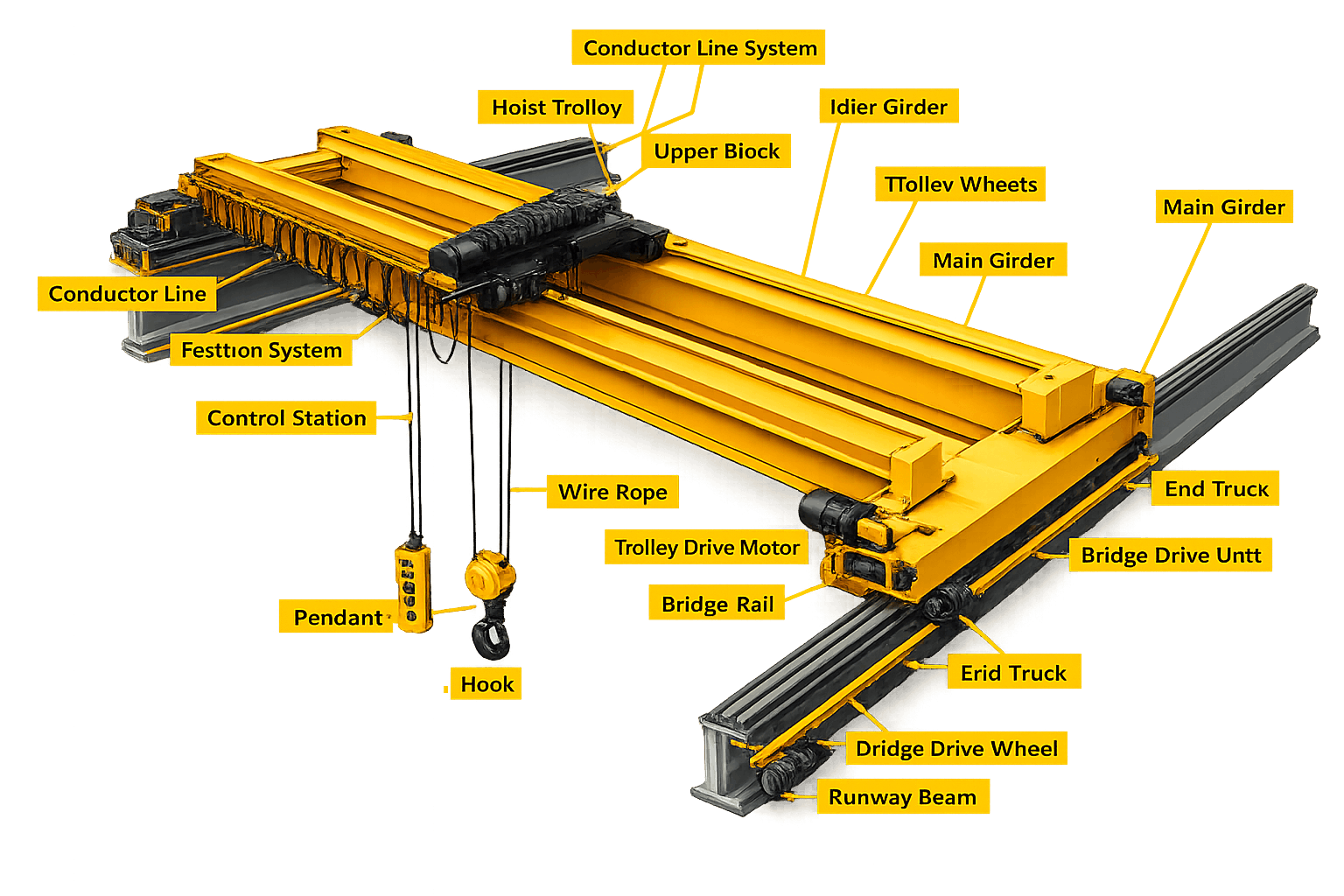
Key Components
Safety Features
Electronic load cell trips the hoist at rated SWL — prevents structural overloading and rope damage on every lift.
Hard limits on hook travel prevent over-hoisting and over-lowering. Emergency limit switch provides secondary protection.
Mushroom-head emergency stop on all control devices — cuts power to all motions immediately and applies brakes.
Infrared sensors detect adjacent cranes or fixed obstacles — automatic deceleration and stop before contact occurs.
Built-in thermistors monitor motor winding temperature and shut down before thermal damage occurs under continuous duty.
Phase-failure relay and voltage monitoring protect all motors from single-phasing, phase reversal, and under-voltage conditions.
Spring or hydraulic buffers at each end of the runway and bridge absorb impact energy and prevent structural damage at travel limits.
Real-time load indicator shows lifted weight in the operator's field of view — supports accurate load management and prevents guesswork.
Encrypted radio remote with dead-man function — signal loss or button release triggers automatic braking on all axes.
Full Specifications
| Parameter | Value / Range | Notes |
|---|---|---|
| Lifting capacity | 1 T — 500 T | Single girder to 25 T; double girder to 500 T |
| Crane span | 4.5 m — 31.5 m | Custom spans available on request |
| Lifting height | 3 m — 30 m | Custom heights available on request |
| Working class | A3 — A7 | FEM / ISO duty classification; A8 on request |
| Lifting speed | 0.5 – 8 m/min | Dual-speed or stepless VFD; load-dependent |
| Trolley travel speed | 2 – 20 m/min | Dual-speed or VFD option |
| Bridge travel speed | 5 – 30 m/min | Dual-speed standard; VFD stepless option |
| Hoist type | Wire rope hoist / Chain hoist | ZX wire rope; VX open hoist for heavy capacity |
| Girder design | Single or double box girder | Rolled profile to 18 m span; welded box beyond |
| Rail system | Top running — rails on runway beam top flange | Regular rail alignment inspection required |
| Control type | Pendant / Radio Remote / Cabin | Dual-speed buttons on all axes; tandem option |
| VFD / Inverter | Optional (standard on heavy duty) | Smooth start/stop; adjustable speed, braking time |
| Power supply | DSL conductor rail / Cable reel | Based on site power supply; 380V–690V 3-phase |
| Operating temperature | −20 °C to +50 °C | Foundry / outdoor / tropical ranges on request |
| Motor protection | IP54 (single) / IP55 (double) | Ex-Proof / ATEX on request |
| Design standards | FEM / DIN / ISO / CE | Full CE documentation; short delivery terms |
Standard & Optional Features
Standard Features
- Dual-speed control on all crane axes (slow/fast)
- Upper, lower & emergency limit switches
- Overload protection — trips at rated SWL
- Emergency stop on all control devices
- Hooter + flasher (travel motion indicators)
- Anti-collision system (infrared)
- End stop buffers (runway and bridge)
- Phase & voltage protection relay
- Thermal motor protection
- DSL conductor rail power supply
- CE certification + full technical documentation
Optional Features
- VFD stepless speed control on all motions
- Radio remote control with dead-man function
- Operator cabin — fixed or travelling
- Anti-sway / electronic sway control
- Load display / digital weight indicator
- Tandem / synchronous multi-crane operation
- Maintenance platform (double girder standard)
- Grab bucket, electromagnet, C-hook, spreader
- Under-girder monorail hoist (second hook)
- Explosion-proof / Ex-Proof / ATEX certification
- Custom RAL / corporate colour finish
Typical Applications
Manufacturing & Assembly
Component transfer, press feed, and sub-assembly handling across workshop overhead crane systems and production lines.
Steel Mills & Foundries
Heavy coil, ladle, and billet handling in continuous casting, rolling, and heat treatment facilities — A6 / A7 duty.
Warehouses & Logistics
Factory overhead crane systems for pallet, coil, and bulk goods handling in distribution centres with existing roof structure.
Harbours & Ports
High-capacity overhead travelling cranes for container loading, ship repair, and heavy cargo transfer at ports.
Power Stations
Turbine, transformer, and reactor component handling where hook height and precise load positioning are critical.
Mining & Heavy Industry
A7-rated industrial overhead crane configurations for ore handling, crusher maintenance, and equipment extraction.
Construction & Precast
Precast element and heavy plant handling in covered construction yards and precast concrete production facilities.
Automotive & Food
High-cycle overhead crane for heavy loads in automotive press shops, and hygienic-grade configurations for food processing.