
Underhung
Overhead Crane Manufacturer
Wheels on the bottom flange — suspended from the building roof structure, no floor columns required. Underhung bridge cranes free the entire floor area for production, deliver excellent side approach, and are the practical choice for lighter-duty lifting in workshops, assembly lines, and warehouses.
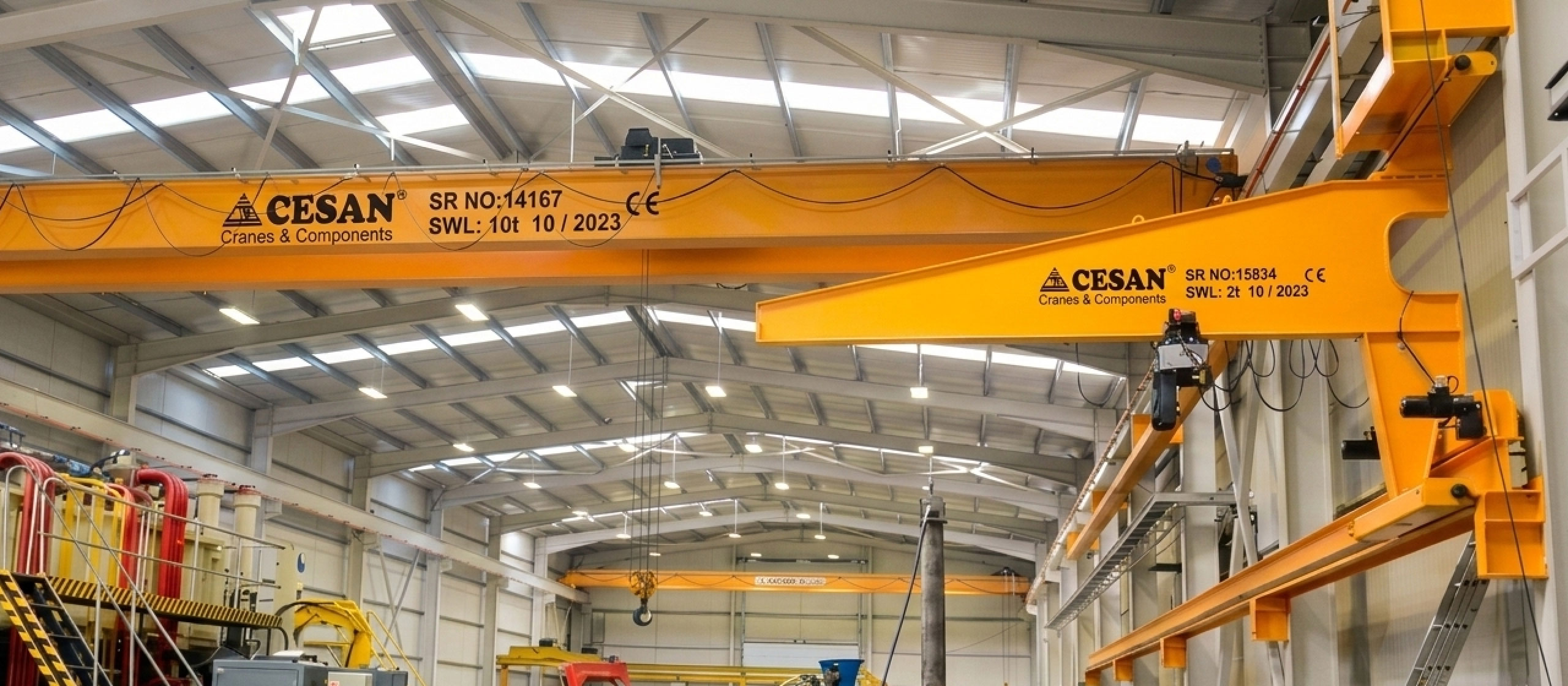
Suspended from
Roof Structure
Free the Floor — No Support Columns
An underhung crane is suspended from the building's existing roof trusses, rafters, or a dedicated overhead support structure. Because there are no floor-mounted columns supporting the crane runway, the entire floor area beneath the crane's travel path is available for production equipment, vehicles, aisles, and workstations. In factories and warehouses where floor space efficiency directly affects throughput, removing the need for dedicated crane support columns can significantly increase usable production area and simplify future layout changes.
Best-in-Class Side Approach
Because the bridge girder and end trucks run on the bottom flange of the runway beam, the underhung crane can position the hook closer to the runway end and closer to the building wall than any top-running design. This optimised end approach and bridge end approach is particularly valuable in buildings where loads must be picked from positions tight against walls, into machine nests, or at the very end of the travel path — maximising the crane's working coverage within the available building width without any wasted dead zones.
Flexible Multi-Runway Layouts
Underhung systems support adjacent parallel runways operating side by side, which is often difficult to achieve cleanly with top-running designs. Individual runway segments can serve sub-areas of the hall and lateral overhang extensions can carry loads beyond the main span. With anti-collision and crane-spacing devices, multiple cranes on a shared runway can operate safely and independently or in tandem for long and unwieldy loads. The modular profile and box-section girder options allow the system to be extended or reconfigured when production structures change.
Underhung Bridge Crane — Space-Efficient Lifting
An underhung overhead crane — also called an under-running crane or suspension crane — differs from a top-running bridge crane in one defining way: the bridge end trucks run on the bottom flange of the runway beam rather than on rails fixed to its top surface. The runway beams themselves hang from the building's roof structure or ceiling trusses, requiring no ground-level support columns anywhere along the crane's travel path.
This configuration is well-suited to lighter-capacity industrial applications, typically up to 16 tonnes, where the priority is floor space efficiency, side approach, and layout flexibility rather than maximum hook height or very heavy lifting. Single-girder underhung cranes are the most common configuration; double-girder underhung cranes are available but are generally less practical and more costly for this crane type and capacity range.
Cesan underhung cranes are available with DVR rope hoists up to 16 T and DC chain hoists up to 5 T, built to FEM, DIN, and CE standards in duty classes A3 through A5. Frequency-controlled VFD travel and hoisting drives are available to prevent load sway and deliver smooth, precise positioning. Before installation, the structural capacity of the building roof must be evaluated to confirm it can carry the suspended crane loads — Cesan's engineering team can advise on this assessment.
- No floor columns — full floor area available for production
- Best end approach and side approach of any crane type
- Maximises usable building width — reaches closer to walls
- Multiple parallel runways possible — adjacent sub-area coverage
- Lateral overhang extensions for reach beyond main span
- VFD frequency control — smooth travel, reduced load sway
- Tandem operation for long and bulky loads
- Lower total system cost in suitable lighter-duty applications
Key Specifications
Roof structure assessment recommended before installation — our team can assist.
Underhung vs Top Running — Which One?
| Parameter | Underhung Under-Running | Top Running Rail-Mounted |
|---|---|---|
| Lifting capacity | Up to 16 T (typically ≤ 10 T)Rope hoist to 16 T; chain hoist to 5 T | 1 T to 500 TSingle girder to 25 T; double girder beyond |
| Support structure | Suspended from building roof / trussesNo floor columns required — roof must be assessed | Dedicated runway columns or building frameIndependent structure; no roof load transfer |
| Floor space | Maximum — no columns on floorEntire floor area free for production | Columns consume some floor areaColumn positions must be planned around workflow |
| Side & end approach | Best availableHook reaches closer to walls and runway ends than any top-running design | Good, but not as closeEnd trucks above runway beam limit hook approach |
| Hook height | LowerHoist hangs below the bridge — loses the runway beam depth as hook height | HigherRails on top of runway; double girder gains additional height |
| Max capacity limit | Limited by roof structureTypically 10 T practical limit; 16 T with strong structure | No practical upper limitStructural design handles 500 T+ independently |
| Multi-crane layouts | ExcellentAdjacent parallel runways; bypass and anti-collision options | GoodMultiple cranes on shared runway with anti-collision |
| Total system cost | Lower in suitable applicationsLighter structure; existing roof used; no extra columns | Higher upfront, justified by capacityIndependent structure needed; higher load capability |
| Best fit | Workshops, assembly, maintenance, light productionWhere floor space, side approach, and layout flexibility matter most | Heavy manufacturing, steel, ports, miningWhere capacity, hook height, and duty cycle are the priority |
Safety Features
Electronic load limiter trips the hoist at rated SWL, protecting the crane structure and building roof from overloading.
Hard limits on hook travel prevent over-hoisting and over-lowering. Emergency limit switch provides secondary protection.
Mushroom-head E-stop on all control pendants and remotes — cuts power and applies brakes on all motions immediately.
Bypass control and anti-collision devices prevent contact with obstacles or adjacent cranes on shared runways.
Spring buffers at each end of runway and bridge absorb impact energy and protect the structure at travel limits.
Thermal protection, phase-failure relay, and brake monitoring ensure safe operation under all load conditions.
Full Specifications
| Parameter | Value / Range | Notes |
|---|---|---|
| Lifting capacity | 0.5 T — 16 T | Rope hoist to 16 T; chain hoist to 5 T |
| Max runway centre | Up to 30 m | Profile-section or box-section girder bridge |
| Max lifting speed | Up to 12.5 m/min | Dual-speed or VFD stepless |
| Cross-travel speed | Up to 32 m/min | Frequency-controlled option for smooth positioning |
| Crane travel speed | Up to 60 m/min | VFD option to prevent load sway |
| Working class | A3, A4, A5 | FEM / ISO duty classification |
| Girder design | Rolled profile or box-section | Single girder standard; double girder available |
| Runway suspension | From building roof / trusses / ceiling | Roof structural assessment required before installation |
| Wheel position | Bottom flange of runway beam | Under-running — not on top of runway |
| Hoist type | DVR rope hoist / DC chain hoist | Rope to 16 T; chain to 5 T |
| Control type | Pendant / Radio Remote | Dual-speed buttons; VFD option on all axes |
| Power supply | Festoon cable or conductor rail | 380V 50Hz 3-phase or to site specification |
| Lateral overhang | Available | Extends cross-travel beyond main span |
| Multi-crane operation | Available | Anti-collision, bypass, tandem; multiple cranes on one runway |
| Ambient temperature | −20 °C to +40 °C | Other ranges on request |
| Design standards | FEM / DIN / CE | Full CE documentation supplied |
Standard & Optional Features
Standard Features
- Dual-speed control on all crane axes
- Upper, lower & emergency limit switches
- Overload protection — trips at rated SWL
- Emergency stop on all control devices
- End-stop buffers on runway and bridge
- Motor thermal & brake protection
- Phase & voltage protection relay
- Festoon cable power supply
- CE certification + full technical documentation
Optional Features
- VFD stepless speed control — smooth travel, low sway
- Radio remote control
- Anti-collision & bypass control (multi-crane)
- Tandem operation (two hoists — long loads)
- Crane spacing devices for multi-crane runways
- Lateral overhang extension beyond span
- Horizontal guide rollers (reduce skew forces)
- Load display / digital weight indicator
- Conductor rail power supply
- Custom RAL colour finish
Typical Applications
Production Lines
Component transfer and in-process handling on assembly lines where multiple floor-level workstations share the production area.
Warehouses & Distribution
Light pallet and goods handling in distribution centres with existing roof structure — no need for additional crane columns.
Workshops & Maintenance Bays
Engine removal, component exchange, and maintenance work in automotive service bays and machine workshops with constrained ceiling height.
Light Metal & Sheet Processing
Sheet coil, aluminium section, and light steel handling in fabrication shops where floor machinery layout must remain flexible.
Food & Pharmaceutical
Hygienically acceptable configurations for ingredient vessel handling and packaging lines in food and cleanroom production environments.
Electronics & Precision Assembly
Smooth, low-vibration lifting in electronics manufacturing and precision assembly environments where gentle load handling is essential.
Multi-Runway Facilities
Side-by-side underhung runways serving different production zones — each independently controlled with anti-collision protection.
Retrofit Installations
Facilities adding lifting capacity to an existing building where installing new runway columns is impractical or too costly.