
Overhead Crane
Manufacturer in Turkey
CESAN is a leading overhead crane manufacturer in Turkey, engineering CE-certified single and double girder, top-running and underslung crane systems from 1 to 250 tonnes. Our factory-built industrial cranes deliver safe, efficient and reliable lifting solutions to customers across Europe, the GCC, Africa, Asia and global markets.
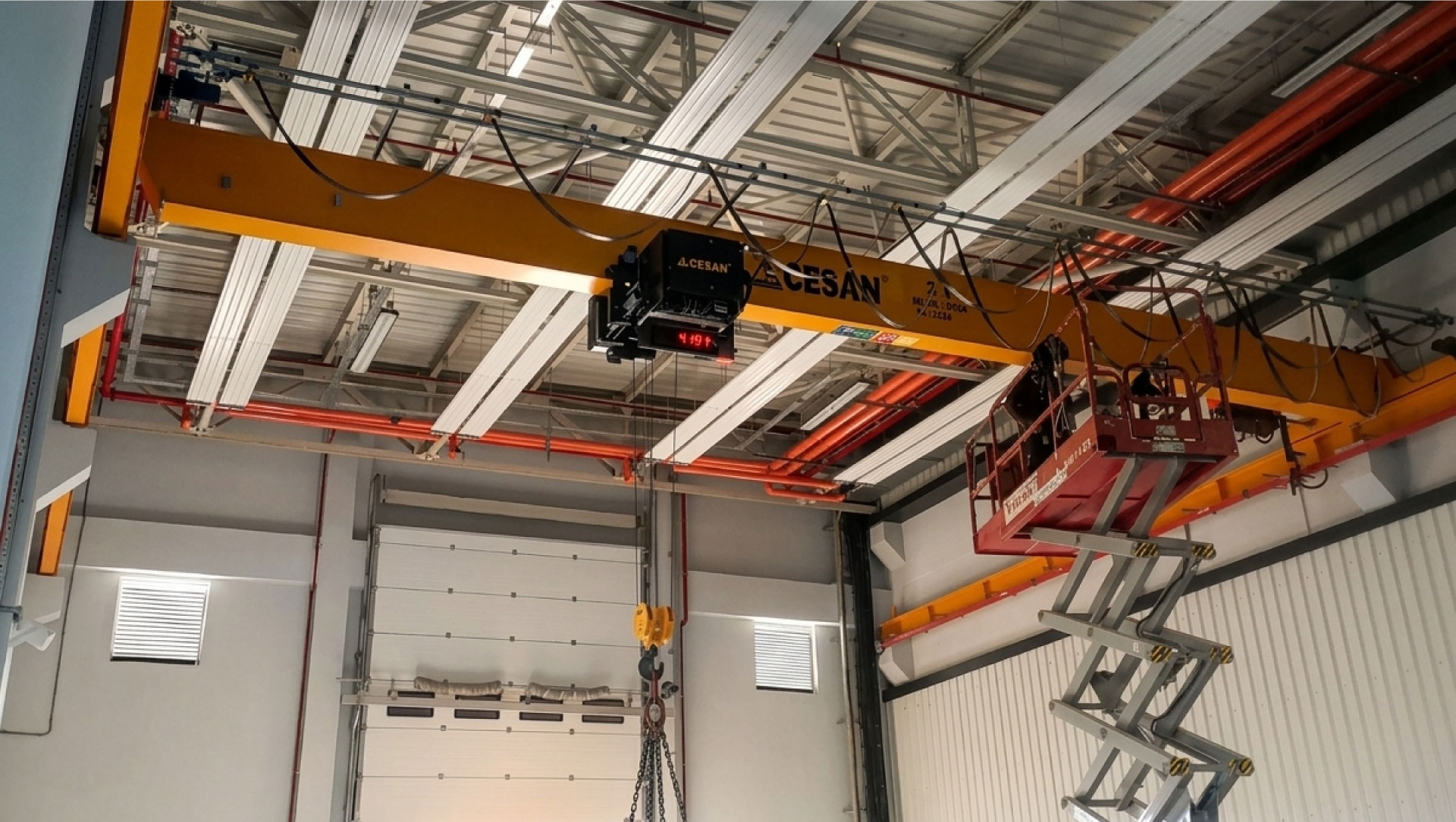
The most popular overhead crane in general industry — and Cesan's most widely specified configuration. A single box-section bridge girder rides on two runway beams, carrying a wire rope or chain hoist below. Lower wheel loads than double girder designs mean reduced runway structure costs, making it the most economical overhead lifting solution for capacities up to 32 tonnes.
Bridge girders are individually adapted to the building ceiling construction with multiple connection variants, allowing optimum space utilisation even in low-ceiling buildings — with better hook approach on both trolley and bridge axes than traditional designs.
- Most cost-effective overhead solution up to 32 T
- Lower wheel loads — reduced runway structure cost
- Wire rope hoist (ZX) or chain hoist (LX) options
- Better hook approach vs. traditional designs
- Low-noise direct drive with disc brake as standard
- VFD frequency inverter for smooth speed control
- Explosion-proof versions available for hazardous areas
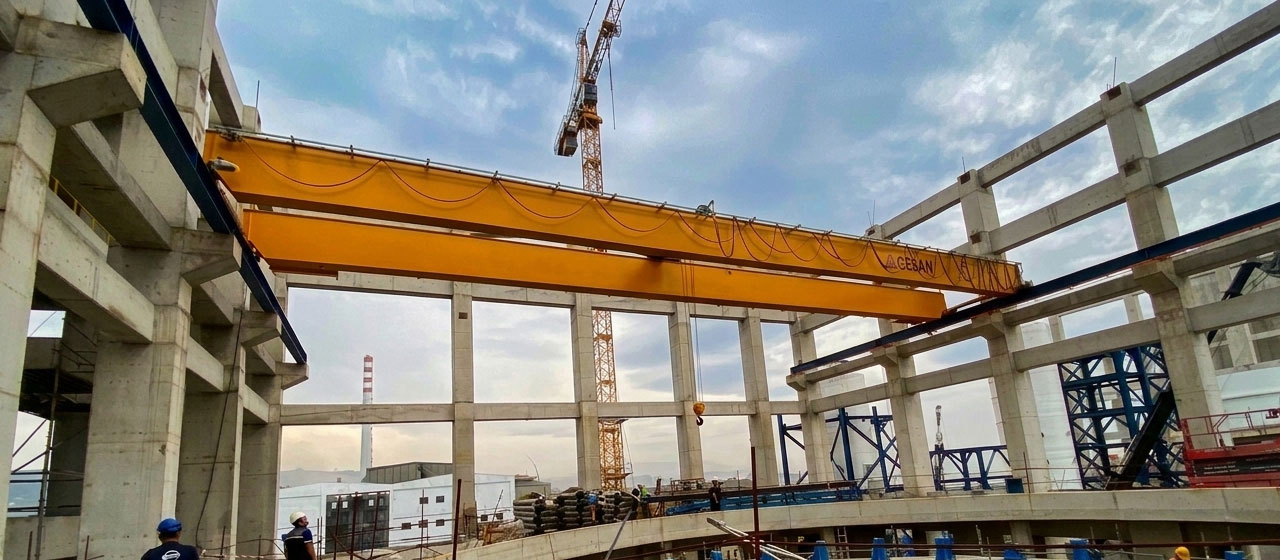
Where maximum lifting height, high capacity, or better hook approach is the priority, the double girder configuration delivers. The trolley (crab) rides on top of twin box girders — putting the hook significantly higher within the building envelope and allowing the crane to be engineered directly into the roof structure.
Available up to 80 tonnes with ZX electric wire rope hoists and up to 250 tonnes with heavy-duty VX open hoists. Four or eight long-travel wheels are selected to match allowable wheel loads, and multiple trolley gauges accommodate different lifting heights and span configurations.
- Maximum hook height — trolley rides on top of girders
- Better side hook approach for large lifting heights
- Up to 80 T (ZX wire rope) or 250 T (VX open hoist)
- 4 or 8 long-travel wheels to match wheel load limits
- Maintenance walkway platform along full girder length
- Operator cabin — fixed or travelling independently
- Grab, electromagnet, and C-hook spreader options
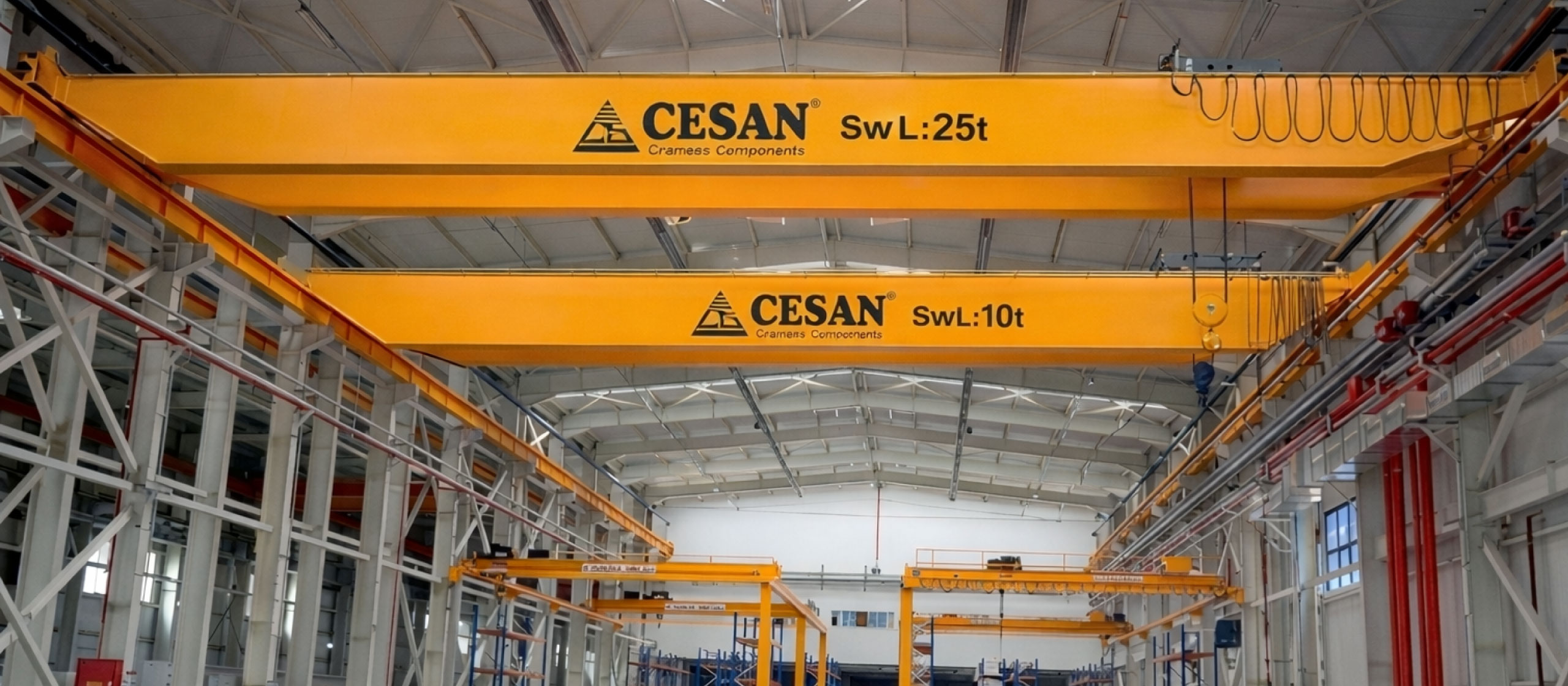
The standard configuration for heavy industrial applications — end trucks ride on the top flange of the runway beam, placing the crane above the rails and maximising available hook height below. This arrangement supports the highest capacities and widest spans in the overhead crane range, and is the preferred choice for new industrial buildings where runway beams can be precisely sized to the application.
Both single and double girder bridges are available in top-running configuration. Low-maintenance direct-drive mechanisms with disc brakes, centrifugal mass damping, and optional VFD frequency inverters deliver smooth, precise travel and hoisting in continuous-duty production environments.
- End trucks ride top flange — maximum hook height below
- Supports the highest capacities and widest spans
- Preferred for new construction — runway sized to load
- Single or double girder bridge available
- Low-maintenance direct drive with disc brake standard
- Smooth start and stop — VFD frequency inverter option
- Explosion-proof versions for hazardous environments
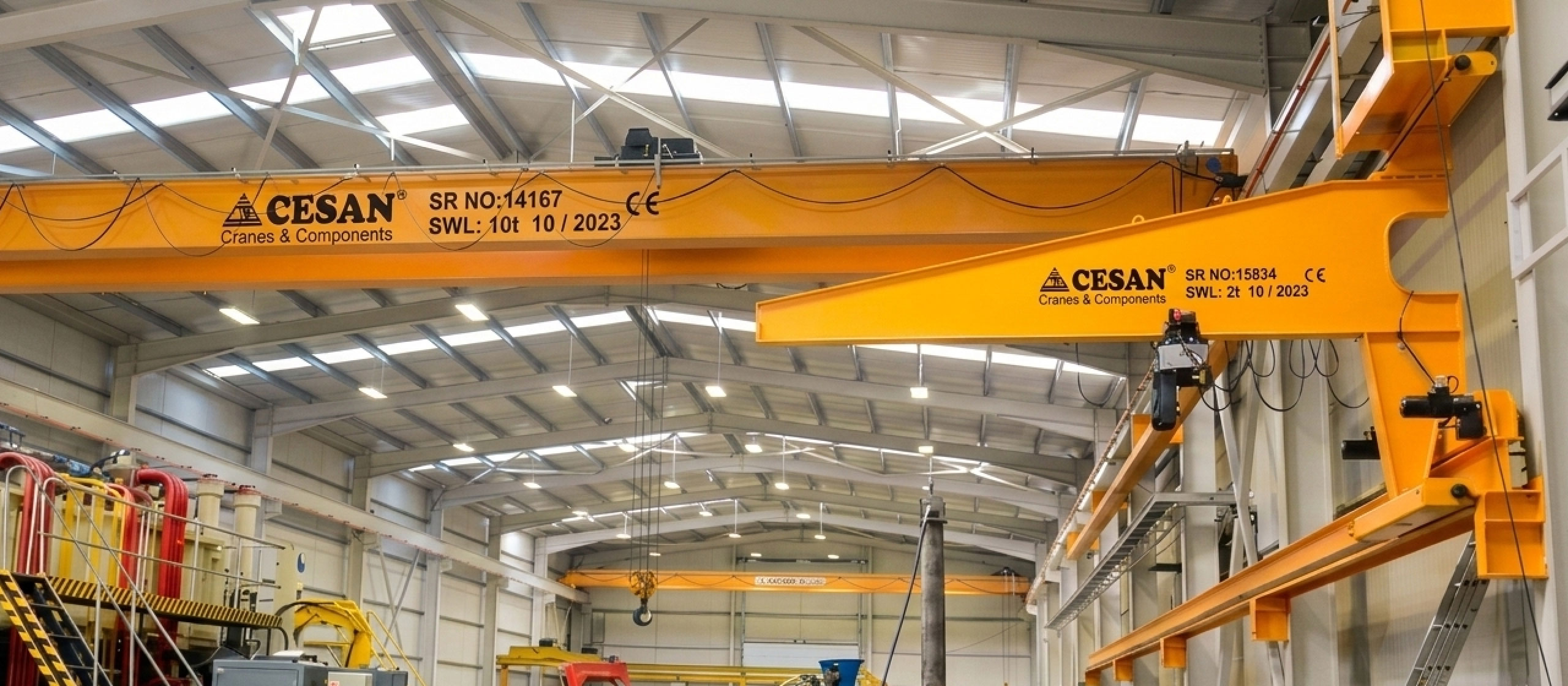
Under-running cranes hang from the bottom flange of the runway beam — the right choice when an existing building structure is used as runway support, or when tight clearances make a top-running profile impractical. The lower end-truck profile allows operation in buildings where headroom is restricted, and the bottom-flange load path means the crane can frequently be installed without modifying the building steelwork at all.
This makes under-running the most retrofit-friendly overhead crane configuration — widely specified for distribution centres, maintenance bays, and any facility where a crane is being added to an existing building without structural alteration.
- Hangs from bottom flange — uses existing structure
- No structural upgrades needed in most retrofit cases
- Ideal for low-headroom and tight-clearance buildings
- Most retrofit-friendly overhead crane configuration
- Chain or wire rope hoist options for all capacities
- Pendant and radio remote control as standard
- CE / FEM / DIN certified — full documentation supplied
CE-Certified Overhead Cranes for International Projects
Manufactured in Turkey, CESAN overhead crane systems are engineered for factories, steel plants, warehouses, workshops, logistics centres, power facilities, mining operations and other demanding industrial applications.
We supply single girder, double girder, EOT, top-running and underslung crane systems for projects across Europe, the Middle East, Africa, North America, Central Asia, the Caucasus and Asia-Pacific. Each system is configured according to lifting capacity, span, duty class, operating environment and destination-market requirements.
Our cranes are engineered to FEM and DIN standards, with CE documentation, technical files and project-specific certification available where applicable.
- Middle East and GCC: Saudi Arabia, the United Arab Emirates, Qatar, Kuwait, Oman, Bahrain, Jordan, Iraq and Lebanon
- Europe: Italy, Spain, Poland, Romania, Bulgaria, Hungary, Serbia, Croatia, Greece, Albania, North Macedonia and Bosnia and Herzegovina
- Africa: Nigeria, Egypt, Algeria, Morocco, Tunisia, Libya, Ghana, Kenya, Tanzania, Ethiopia and South Africa
- North America: the United States, Canada and Mexico
- Central Asia and Caucasus: Kazakhstan, Uzbekistan, Azerbaijan, Georgia, Turkmenistan and Kyrgyzstan
- Asia-Pacific: Pakistan, Bangladesh, Indonesia, Malaysia, Vietnam and the Philippines